
A detergent powder sieve test is only as reliable as the sieve apertures, sample condition, operating method, and mass balance behind it. By defining those controls, you can choose the right shaker, produce a defensible particle-size distribution, and decide when another powder-testing method is more suitable.
Key takeaways
- Report mass retained, undersize, and percentage passing for every sieve.
- Dry the sample and break soft lumps before testing; do not crush hard agglomerates.
- Keep sieve loading within the method limit to prevent biased particle-size results.
- Choose laser diffraction or wet sieving when powder is too fine, cohesive, or soluble.
What a detergent powder sieve shaker actually measures
A sieve shaker produces a particle-size distribution: the mass retained on each sieve, the undersize collected in the pan, and the percentage passing each aperture. It does not measure dissolution rate, cleaning performance, active-ingredient concentration, moisture, bulk density, or flowability.
Before buying a powder testing sieve shaker, define the stack and the result you need. Select a dry, wet, or air-assisted method, then specify the aperture range, sample mass, shaking time or endpoint, and whether you need a full distribution or only a pass/fail screen.
| Stack choice | Result produced | Define before testing |
|---|---|---|
| Coarse-to-fine apertures | Retained mass by size fraction | Largest opening at the top and smallest validated opening above the pan |
| One critical aperture | Percentage passing or retained at one cut size | The target aperture, sample mass, and pass/fail limit |
| Fine apertures with air assistance | Separation of cohesive fine powder | Airflow setting and whether it may break agglomerates |
For detergent powder, state whether you are measuring manufactured granules or primary particles. Gentle dry sieving preserves granule size; vigorous tapping, brushing, or airflow can break agglomerates and report a finer distribution. A 200 mm or 300 mm sieve diameter changes usable area, not the definition of accuracy.
A detergent and powder testing equipment sieve shaker in Mumbai is suitable only when its motion, clamping, clearance, and sieve diameter match that method.
How to run a dry detergent powder sieve test
Use a defined sample mass and a written method, not a convenient scoop. Record the powder condition, sieve identification, aperture sizes, motion setting, and sieving duration before starting.
1. Weigh the prescribed sample mass on a calibrated balance. Transfer it carefully and record the exact starting mass.
2. Inspect clean, dry sieves, then stack them from the largest aperture at the top to the smallest at the bottom. Place the pan beneath the finest sieve and confirm that every sieve has its identification and aperture recorded.
3. Pour the sample into the top sieve, fit the lid securely, and clamp the complete stack. A loose lid or poor clamping lets powder escape and changes the retained fractions.
4. Set the documented shaker motion, amplitude or speed, and duration. Do not substitute an orbital-only setting for a method requiring tapping. If your method specifies an endpoint, continue until that endpoint is reached; otherwise use the stated time consistently. This applies whether you operate a detergent powder sieve shaker in Mumbai or another laboratory.
5. Remove the stack carefully and weigh the material retained on every sieve, including the pan fraction. Brush each fraction into a labelled container without forcing particles through the mesh.
Compare the sum of all retained fractions with the original sample mass. Record the recovered mass, percentage retained on each sieve, visible agglomerates, and mesh blinding before reporting the result.
How moisture, caking, static, and overloading change the result
Condition the powder before sieving: moisture uptake makes hygroscopic salts and surfactants cake, shifting mass into larger apparent fractions and blinding fine apertures. Store the sample in a sealed container, then record conditioning time, temperature, and humidity before comparison.
1. Break only loose agglomerates with the method’s defined preparation. Do not grind hard lumps; that changes the particle-size distribution you are trying to measure.
2. Inspect the mesh after each run. Caked powder, static-charged fines, or excess sample can cover openings and reduce passage, producing falsely high retained mass. Stop and record visible blinding.
3. Load an appropriate mass for the sieve diameter and powder. Overloading a 200 mm or 300 mm sieve forms a thick bed, while static makes fines cling to the sieve, lid, or frame instead of passing.
4. Use the same powder testing sieve shaker setting and endpoint for every test. Hand-sieving applies different force and duration, so its result is not directly comparable with mechanical shaking.
5. Brush or tap retained material into the weighing container without forcing particles through the mesh. Transfer the pan, lid, and sieve contents completely; collect cleaning powder separately, because loss during cleaning reduces recovery and distorts every percentage.
How to calculate, balance, and report the particle-size distribution
Report the distribution as mass retained on every sieve and the pan, not as a single average particle size. Calculate percentage retained, cumulative retained percentage, and percentage passing for each aperture.
- Weigh the retained fraction, mi, from each sieve and pan. Record the sieve identification and aperture beside it.
- Calculate percentage retained as mi ÷ M0 × 100, where M0 is the initial sample mass.
- Calculate cumulative retained percentage by adding percentages from the coarsest sieve through that sieve. Calculate percentage passing as 100 minus cumulative retained percentage.
- Balance the test using total recovery: add every retained fraction, divide by M0, and multiply by 100. Investigate loss, rather than silently correcting it, when recovery falls outside the limit set in your method.
- Report sample conditioning, test duration or endpoint, sieve stack, and visible agglomeration or mesh blinding. State whether you measured intact manufactured granules or deliberately deagglomerated particles.
- Run replicates under identical conditions. At each aperture, report the absolute difference in percentage passing between replicates and compare it with your laboratory acceptance limit.
A result from a detergent powder sieve shaker in Mumbai is incomplete without these calculations and observations. Retained fractions reveal coarse material, fines, segregation risk, and possible dissolution differences that an average size conceals.
When a sieve shaker is the wrong powder-sizing method
A mechanical powder testing sieve shaker is the wrong choice when the powder’s behaviour prevents reliable separation through the mesh. Searching for a detergent and powder testing equipment sieve shaker in Mumbai does not settle that decision; define whether you need granule size, primary-particle size, or only a pass/fail screen.
| Option | What it measures | Choose it when |
|---|---|---|
| Mechanical sieve shaker | Mass retained on each sieve | Coarse or medium, free-flowing powder needs a repeatable dry test |
| Laser diffraction analyser | Optical equivalent diameter, often across a very fine range | You need sub-100-micrometre detail or a rapid fine-particle distribution; results are not directly interchangeable with sieve fractions |
| Air-jet sieve | Fine material drawn through one sieve by controlled airflow | Fine, cohesive powder blinds mesh; airflow can break weak agglomerates and alter the result |
| Hand sieve | Operator-dependent retained fraction | You need a quick check, not strong repeatability |
| Simple sieve stack | Screening by manual shaking without controlled motion or time | You need a basic pass/fail screen |
Electrostatic detergent powder needs grounding and anti-static controls before choosing either method. For agglomerated powder, state whether you are measuring manufactured granules or primary particles: brushing, hard tapping, or air pressure can create a different answer.
What to ask a Mumbai sieve shaker supplier before you buy
A quotation from a sieve shaker supplier in Mumbai should describe the complete measurement system, not just the motor. The test sieve is the measurement element; a timer cannot correct blocked mesh or an out-of-tolerance aperture.
1. Ask for sieve certificates or inspection reports identifying the standard, nominal aperture, frame diameter, material, and marking. Confirm compatibility with ISO 3310-1 and specify the aperture series, which spans approximately 20 µm to 125 mm, rather than naming only the stack diameter.
2. State whether your method is dry, wet, or air-assisted, along with sample mass, required sieve apertures, sieving time or endpoint, and reported result. Confirm stack height clearance, sieve diameter, clamping pressure, pan and lid fit, and noise and vibration limits.
3. Ask whether the shaker provides documented or controllable amplitude, speed, and motion. Orbital motion and tapping are not interchangeable; request tapping action when your existing method uses it, plus the timer range and electrical rating.
4. Require a verification method, service records, and support for on-site or laboratory performance checks. Ask for spare clamps, seals, pans, lids, and replacement sieves, and get the warranty response time in writing.
5. Confirm that a detergent powder testing equipment sieve shaker in Mumbai is not a moisture analyser, density tester, flow tester, dissolution tester, or active-ingredient instrument. J.M. Engineering and Instruments can help match shaker hardware and support checks, but your laboratory must validate the method and acceptance criteria.
Related product
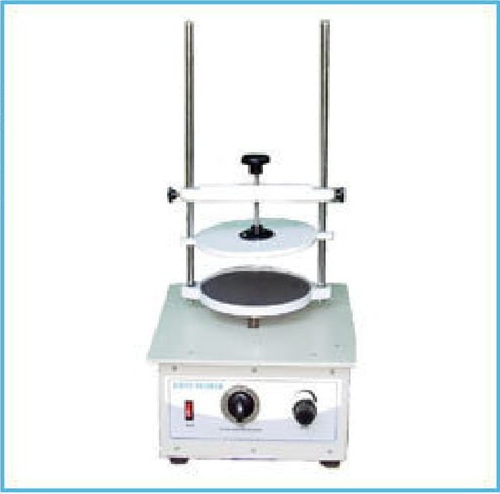 | Testing Equipments J. M. ENGINEERING & INSTRUMENTS Sieve Shaker Manufacturer & Supplier J. M. View product → |
Frequently asked questions
What does a detergent powder sieve shaker measure?
It measures particle-size distribution by recording the mass retained on each sieve, the pan fraction, and the percentage passing each aperture. It does not measure dissolution, cleaning performance, active-ingredient concentration, moisture, bulk density, or flowability.
How do you run a dry detergent powder sieve test?
Condition and weigh a representative sample, stack sieves from largest to smallest aperture with a pan beneath, add the sample, secure the lid, shake for the specified time and intensity, then weigh material retained on every sieve and in the pan.
Why do moisture, caking, static, and overloading affect sieve results?
Moisture creates cohesive lumps, caking leaves particles trapped in agglomerates, static makes powder cling to sieve surfaces, and excessive loading blocks apertures. Control each condition or record it as a test deviation.
How is detergent powder particle-size distribution calculated?
For each sieve, divide retained mass by total recovered sample mass and multiply by 100. Calculate cumulative passing by subtracting cumulative retained percentage from 100, then check the mass balance.
When is a sieve shaker the wrong powder-sizing method?
Use another method when particles are below the practical sieve range, dissolve or deform during wet sieving, remain strongly cohesive, or require a volume-based measurement of very fine particles. Laser diffraction or image analysis may fit those samples better.