
A dyne pen is only useful when its nominal values, test liquids, application method, and pass criterion are known. By the end, you will be able to match a pen set to your substrate and process, interpret the result correctly, and check whether a supplier’s quotation contains enough information for controlled production testing.
Key takeaways
- Record each pen’s dyne range, increment, expiry date, and certificate details.
- Clean and dry the surface before drawing one continuous test line.
- Accept the highest value that remains a continuous film for two seconds.
- Treat rough, porous, contaminated, or textured surfaces as possible sources of false readings.
What a dyne value actually measures
A dyne value reports wetting tension: the test liquid’s ability to form a continuous film on a surface. The unit is dynes/cm, numerically equal to mN/m because 1 dyn/cm equals 1 mN/m. Therefore, 38 dynes/cm means 38 mN/m, not 38 mN/cm.
- Untreated polyethylene and polypropylene often measure around 30–34 dynes/cm because their nonpolar surfaces resist wetting.
- Printing, coating, and laminating processes may specify approximately 38–44 dynes/cm after corona, plasma, or flame treatment.
- The target is process-specific. A higher number is not automatically better; select the level required by the ink, adhesive, coating, substrate, and production step.
A dyne pen is a threshold screening tool, not a direct measurement of thermodynamic surface energy. Its result depends on the calibrated liquid, contact time, line thickness, surface roughness, porosity, contamination, and operator interpretation.
A continuous line indicates wetting at the liquid’s nominal value during the stated observation period; it does not prove final adhesion or bond strength.
ASTM D2578 is the standardized wetting-tension test for treated polyethylene and polypropylene films. A pen intended for glass, metal, paper, foil, coated stock, or finished parts is not automatically ASTM D2578-compliant. The supplier must define the test procedure, applicable surface, observation time, and limitations before using that claim.
Which specifications belong on the pen set
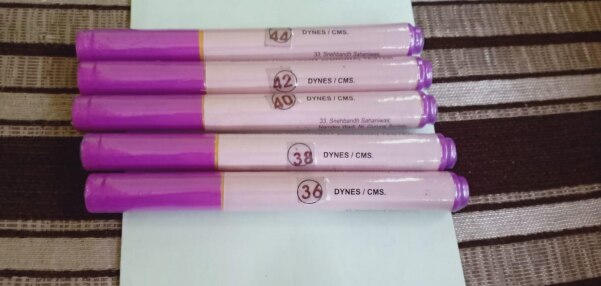
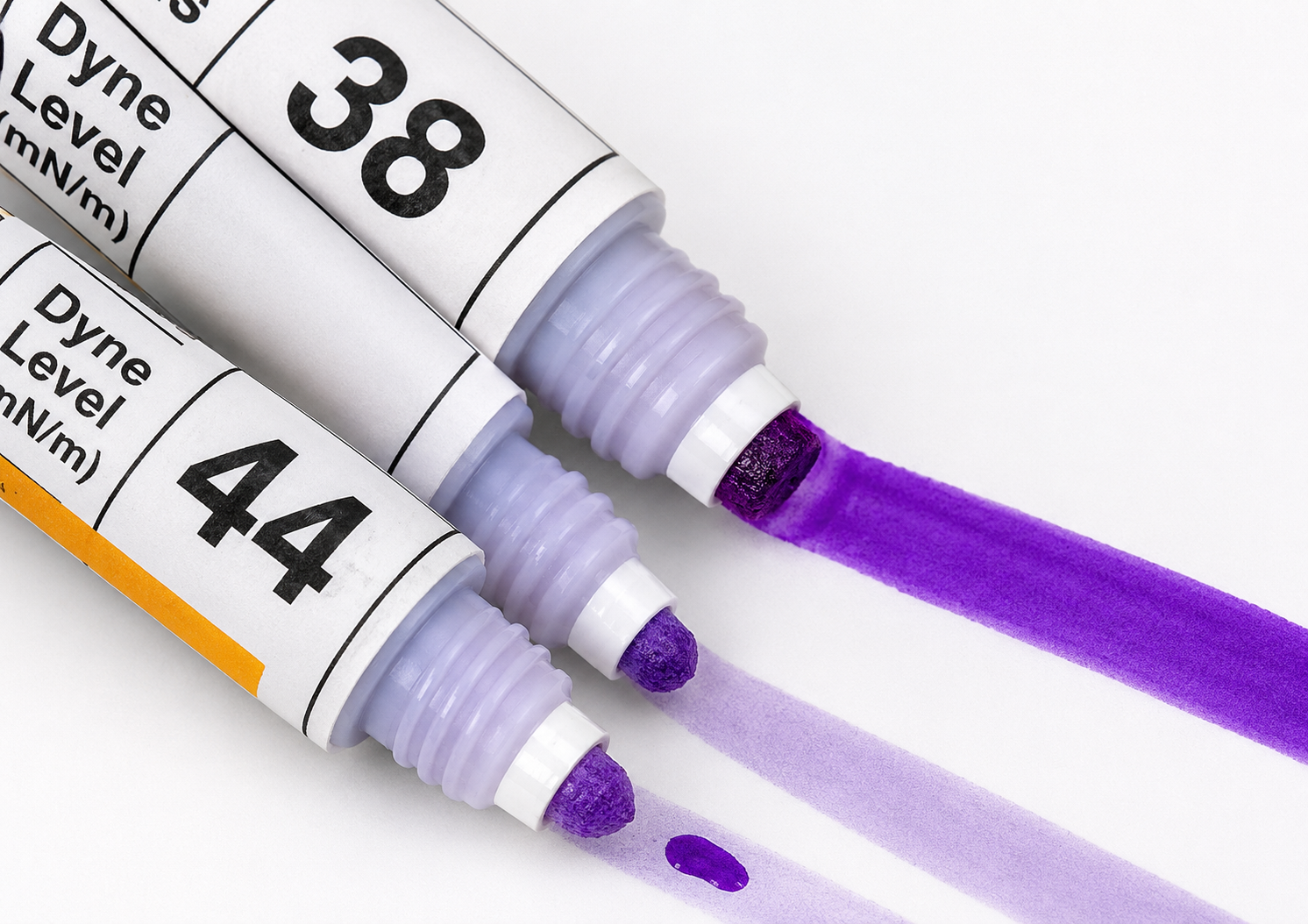
A complete pen set specification must state its lowest and highest nominal dyne levels, every increment between them, and the test method behind each value.
A buyer searching for an industrial tools manufacturer dyne value pen for specifications in Mumbai should confirm whether the set includes 30, 32, 34, 36, 38, 40, 42, 44, and 46 dynes/cm.
Ask the supplier to document:
- Calibrated dyne ink or test-fluid chemistry, including solvent information
- Pen-tip material, applicator geometry, marking width, and fluid volume
- Separate identification, batch or lot number, and expiry or recommended-use date for every pen
- Nominal-value tolerance, shelf life, storage-temperature limits, and transport conditions
- Compatibility with polyethylene film, polypropylene film, laminated film, paper, foil, coated stock, glass, and metal; reject “universal” without a defined surface list
- Whether the set is ready to use or contains refill bottles and laboratory inks
- Whether ASTM D2578 applies only to treated polyethylene and polypropylene film, or whether another written procedure covers additional surfaces
| Supply form | What you receive | Specification to confirm |
|---|---|---|
| Ready-to-use pen set | Filled pens with fitted applicators | Value, tip design, volume, batch and expiry |
| Refill bottles | Fluid for an existing pen body | Chemistry, compatible applicator, storage and refill life |
| Laboratory inks | Test liquid requiring controlled application | Dispensing method, volume, stroke geometry and pass rule |
Do not treat equal labels from different brands as interchangeable; formulation and tip condition can change the result.
How to perform and read a dyne pen test
A continuous wet film is a pass at the stated observation time: the liquid’s nominal surface tension is at or below the substrate’s effective wetting level. Beading, rapid shrink-back, or breaks indicate inadequate wetting; delayed breakup is not a valid failure unless the method defines when to read it.
1. Condition a representative sample, recording temperature and relative humidity. Let condensation clear before testing.
2. Select a clean, representative area. Keep fingerprints, dust, oil, silicone, slip additives, and residues away; state whether cleaning is permitted, because wiping can alter the surface.
3. Follow a written method that specifies stroke or cross-hatch length, stroke speed, contact pressure, line width, test direction, observation time, and pass/fail rule.
4. Apply one controlled stroke or cross-hatch with the selected pen. Do not press repeatedly on the same area or use an unspecified amount of fluid.
5. Read the film at the defined time. Record the nominal dyne level, result, sample identity, operator, temperature, humidity, and pen batch.
6. Reject the result if the pen was left uncapped, or if its tip is dried, contaminated, worn, or damaged. Do not clean a questionable tip and return it to service.
For production trending, use the same validated brand and nominal level. Formulation, solvent loss, dye concentration, tip condition, and pass criteria vary between brands, so two pens marked 38 dynes/cm are not automatically interchangeable.
Where a dyne result is useful—and where it misleads
A dyne result is a screening signal: it tells you whether a surface is likely to accept a particular ink, coating, or adhesive. It does not provide peel strength, rub resistance, bond strength, or adhesion data. Keep those tests in the release plan when failure could cause delamination, scuffing, or package opening.
1. Test a clean, representative area. Dust, oil, silicone, slip additives, cleaning residue, fingerprints, and condensation change the result. Control wiping in the method because cleaning immediately before testing can alter the surface.
2. Treat porous paper and absorbent coatings with caution. Pen liquid can penetrate and appear to form a wet film without proving that the intended ink or adhesive will anchor. Rough or textured material can break the line mechanically, not because its wetting threshold is too low.
3. Check treated film at defined workflow points. Corona, plasma, and flame treatment can decay, especially on polyolefin films. Test immediately after treatment and again before printing, coating, or lamination; a single incoming inspection can miss the decline.
4. Record the observation time and pass rule. A continuous film means the liquid’s nominal value is at or below the substrate’s effective wetting level at that time; beading, shrink-back, or breaks indicate inadequate wetting.
A surface tension testing tool in Mumbai is not automatically a dyne pen. A pen compares substrate wetting with calibrated liquids, while a tensiometer measures liquid surface tension or interfacial tension through a defined instrument method. Neither replaces the other.
How to compare a Mumbai supplier’s quotation
A quotation for a dyne value pen in Mumbai is incomplete if it states only “38 dynes/cm.” Require the lowest and highest nominal values, every increment, substrate scope, calibrated test-liquid formulation, tip design, marking width, fluid volume, observation time, pass criterion, batch or lot identification, shelf life, and replacement policy.
| Offer type | What the quotation must identify | Purchasing risk |
|---|---|---|
| Complete pen set | Included nominal levels, case contents, ready-to-use status, and expiry dates | Missing levels or expired fluids |
| Individual pens | Value, batch number, tip specification, and replacement availability | Inconsistent replacements |
| Refill fluids | Formulation, compatible pen, volume, storage life, and lot traceability | Wrong chemistry or contaminated refills |
| Laboratory ink bottles | Intended procedure, applicator method, and substrate limitations | Not equivalent to a pen system |
Ask the dyne testing pen supplier for:
- SDS, solvent and chemical-handling instructions, ventilation and PPE requirements
- Storage-temperature limits, transport restrictions, and disposal instructions
- The procedure used to assign each stated value, including the observation time and continuous-film pass rule
- Written limitations for polyethylene, polypropylene, laminated film, paper, foil, coated stock, glass, and metal
Do not treat 38 dynes/cm as interchangeable across brands. Solvent volatility, dye concentration, tip condition, and pass criteria change the result. Evaluate J.M. Engineering and Instruments by requesting these same documents, then compare them with your substrate, treatment line, and quality-system records—not range or price alone.
Related product
 | Testing Equipments J. M. ENGINEERING & INSTRUMENTS Dyne Value Pen Manufacturer & Supplier J. M. View product → |
Frequently asked questions
What does a dyne value measure?
A dyne value reports wetting tension: a liquid’s ability to form a continuous film on a surface. Dynes/cm and mN/m have the same numerical value.
Which specifications should a dyne pen set include?
Check the pen range, increment, liquid formulation, lot or batch number, manufacture and expiry dates, storage conditions, cap design, and calibration or certificate documentation.
How do you perform a dyne pen test?
Clean and dry the test area, draw a short line with the pen, and watch it for about two seconds. A continuous film indicates that the surface meets or exceeds the pen’s marked value; beading or shrink-back indicates it does not.
When can a dyne pen result mislead you?
Results become unreliable on dusty, oily, wet, porous, rough, textured, or chemically changing surfaces. Surface temperature, pressure, dwell time, and ink condition also affect interpretation.
How should you compare a Mumbai supplier’s dyne pen quotation?
Compare the included dyne range, number of pens, replacement cost, expiry dating, documentation, storage guidance, delivery terms, GST treatment, and after-sales support rather than comparing the pack price alone.