
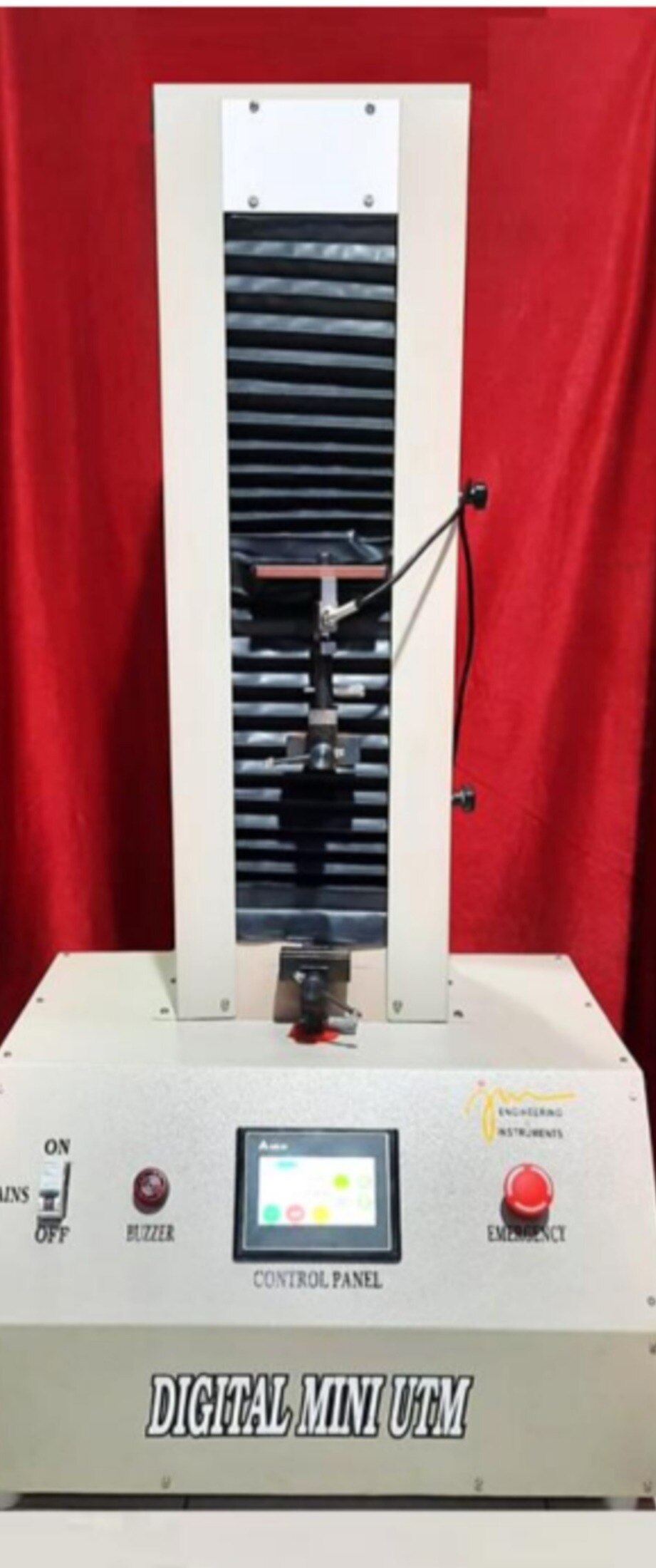
A top-load result can change because of humidity, platen alignment, closure contact, compression speed, or a damaged load cell—not because the package design changed. By the end, you will know how to define the test, prevent common Mumbai laboratory failures, specify the instrument, and verify a supplier’s claims with your own bottles, cartons, and containers.
Key takeaways
- Record force against displacement, not peak load alone.
- Condition packages at controlled temperature and humidity before testing.
- Match platen speed, travel, load range, and test method to the package.
- Ask the supplier to demonstrate repeatability using your own samples.
What a Top-Load Test Measures—and Which Package Failures It Reveals
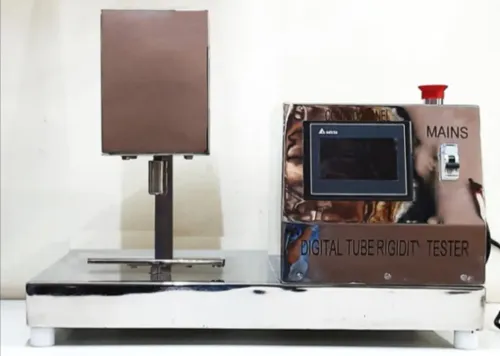
A digital top-load tester measures the compressive force required to deform or collapse a bottle, jar, carton, cup, or other package. It records force against displacement during platen movement, producing a peak load and showing how the package behaved before failure.
That is different from a complete stacking test, which can require sustained load, defined orientation, conditioning, and humidity exposure.
If you are assessing a digital top load tester for packaging laboratory equipment in mumbai, match its result to the failure you need to find. Packaging laboratory testing equipment may support PET and HDPE bottles, pharmaceutical containers, corrugated cases, cups, and filled or empty packs, but the fixture and method determine what the reading means.
| Test output | What it shows | Failure it can reveal |
|---|---|---|
| Peak compressive force | Maximum load before collapse or a defined stop | Buckling, carton crushing, or sidewall instability |
| Force-displacement curve | Sudden loss of load or gradual deformation | Panel collapse, fracture, or permanent deformation |
| Post-compression inspection | Physical damage after unloading | Cap deformation, closure damage, or leakage |
| Load-hold response | Capacity to carry force over time | Creep, sustained buckling, and delayed collapse |
A premature low reading can come from an off-centre bottle, warped carton, non-parallel platens, incorrect closure torque, or a platen touching the cap. Inspect the specimen and confirm alignment before blaming the load cell. A box that passes a short top-load test can still fail during humid, long-duration warehouse stacking.
How to Run a Repeatable Top-Load Test in Mumbai Conditions
Condition specimens in the laboratory atmosphere specified by your test method, not beside an open loading bay. Record temperature, relative humidity, conditioning duration, and moisture history; testing a corrugated case straight after monsoon exposure is not equivalent to testing it after controlled conditioning.
1. Identify the exact package revision. Record resin grade or recycled-content percentage when known, bottle or carton dimensions, fill level, closure type, cap torque, and whether the specimen is filled or empty. Do not label every nominally identical pack “500 mL.”
2. Inspect each specimen before loading. Reject packages with dents, leaks, crushed corners, warped panels, damaged threads, or visibly uneven walls, and record the rejection reason. Use the sample count required by the governing method.
3. Position the specimen on the centreline using a centring guide. Keep the base stable, prevent bottles from rocking, and ensure a carton’s intended top and bottom faces are correctly oriented. Check platen parallelism before the series; a tilted platen can cause early collapse or an artificially high force.
4. Apply the method-defined preload, compression speed, and stopping rule. Keep the platen from touching a cap unless the method requires cap loading. Stop at the specified peak, collapse, displacement, leakage, or permanent-deformation limit rather than choosing a convenient endpoint.
5. Save each specimen’s peak load, displacement, failure mode, speed, and test time. Report the mean and standard deviation or coefficient of variation, not only the highest value. Include the conditioning records and instrument identification so top load testing problems in Mumbai can be traced to humidity, specimens, or setup.
Specifications That Determine Whether the Digital Result Is Trustworthy
Require a witnessed acceptance test using your actual PET bottle, closure, corrugated case, or pail. A generic rigid sample proves little. Ask the digital top load tester supplier to document repeatability across multiple specimens, speed verification, force verification, emergency-stop operation, report export, and recovery after a power interruption.
| Specification | Require | Reject |
|---|---|---|
| Force | Capacity based on expected failure load; stated accuracy, overload protection, sampling rate, and peak, deflection, or hold-load reporting | Largest available cell with no usable working range or overload limit |
| Displacement | Defined travel, resolution, accuracy, zeroing limits, and indication of platen movement | Displayed crosshead position with no displacement verification |
| Speed | Method-specified range, speed accuracy, and controlled rate after platen contact | A nominal speed setting that changes under load |
| Data | Raw and calculated results, specimen identification, CSV or equivalent export, retained files, and restart recovery | Results trapped in the controller or lost after a computer restart |
| Calibration | Traceable load and displacement certificates naming the serial number, test points, tolerance or uncertainty, and as-found/as-left condition | Load-cell certificate presented as proof of complete instrument calibration |
Select capacity from the expected failure load: an oversized load cell reduces low-force resolution, while an undersized one risks overload and calibration loss. Confirm platen alignment separately; load calibration does not verify it.
Before acceptance, trigger the overload alarm, test the protected emergency stop, verify automatic zero and the manual zero check, and interrupt power during a saved test. The procedure must state how you recover or export the file without corrupting the result.
Choose the Test Method Before You Choose the Machine
A machine rated for 10 kN is not automatically suitable for every top-load method. The method determines the contact area, specimen support, loading rate, travel, stopping point, and whether the container is tested empty, capped, filled, or under a sustained load.
| Method | Fixture and configuration required | What fails if you ignore it |
|---|---|---|
| ASTM D2659 | A column-crush setup for blown thermoplastic containers, with controlled platen contact and centring that applies load to the specified container region | Contacting the cap, neck, or shoulder incorrectly changes the collapse mode and invalidates the comparison |
| ASTM D4577 | Compression platens sized for the shipping container, defined orientation, controlled crosshead movement, and the specified compression or hold sequence | A bottle tester with the wrong platen travel cannot reproduce a shipping-container compression result |
| ISO 8113 | A vertical-load fixture suited to the container geometry, with stable support and load applied along the specified axis | Off-centre loading creates bending and reports container weakness as a fixture error |
| Customer-specific method | Match the customer drawing, closure torque, filled or empty condition, conditioning, speed, preload, displacement or hold limit, and failure definition | A standard fixture can produce a number that the customer will reject |
Ask for method-specific drawings and a demonstration using your package, not a generic bottle. Include fixture interchangeability, platen parallelism, speed control after contact, and software fields in your comparison of packaging laboratory testing equipment.
Many top load testing problems in Mumbai begin with a cap-touching platen, an off-centre specimen, or a customer method omitted from the purchase specification.
How a Mumbai Buyer Can Test the Supplier Before Purchase
A supplier comparison should show whether the machine performs your method, not whether its frame carries a large load.
For a digital top load tester for packaging laboratory equipment in Mumbai, compare maximum and usable force, compression stroke, platen size, speed range and accuracy, fixture options, conditioning-room compatibility, calibration method, export format, power requirements and local service response.
1. Send the digital top load tester supplier your exact method and package revision. State whether the specimen is a PET bottle, HDPE container, pharmaceutical bottle, corrugated case, cup or pail; record resin, recycled content, closure, cap torque, fill level and orientation.
2. Witness tests on your actual local specimens, not a generic rigid sample. Require repeated runs across multiple specimens, with the same preload, platen alignment, conditioning and stopping rule used in your laboratory.
3. Verify force at several points across the working range, programmed crosshead speed after specimen contact, zero stability after warm-up and the result’s repeatability. A display reading alone proves little.
4. Trigger the emergency stop and confirm controlled motion, overload alarms and safe platen return. Ask the supplier to demonstrate recovery after a power interruption, including preservation or export of completed test files.
5. Inspect the acceptance record before signing: method, specimen identity, raw data, speed, peak force, failure description, calibration evidence and deviations. Reject any proposal that offers only maximum load for a stacking method requiring hold time, defined orientation or controlled travel.
J.M. Engineering and Instruments should identify these acceptance checks in writing before installation, so the purchase specification and witnessed result match your laboratory’s actual work.
Related product
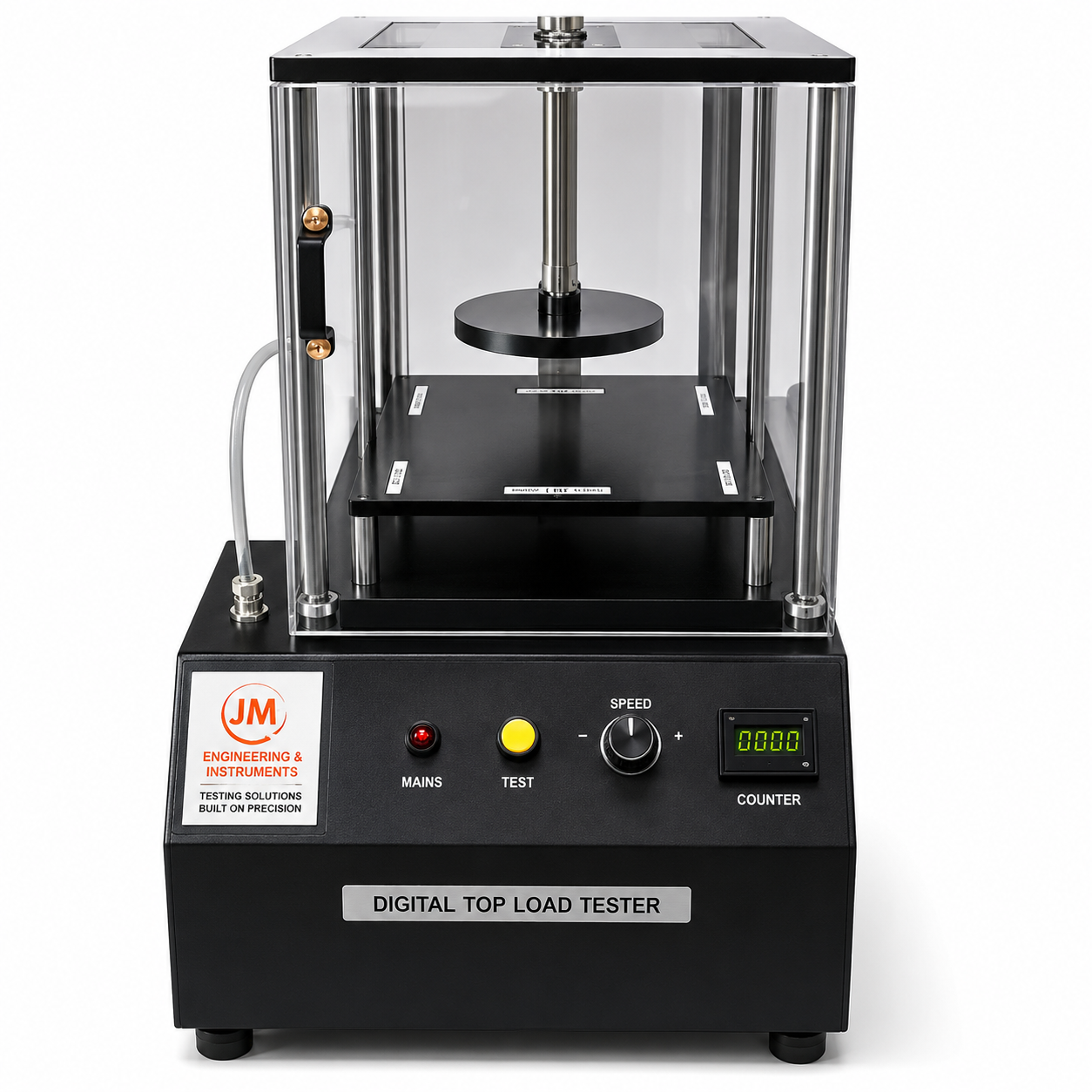 | Testing Equipments J. M. ENGINEERING & INSTRUMENTS Digital Top Load Tester Manufacturer & Supplier J. M. View product → |
Frequently asked questions
What does a top-load test measure?
It measures the compressive force applied to a package and records force against platen displacement, including peak load and behaviour before collapse.
How do you make top-load tests repeatable in Mumbai conditions?
Control sample conditioning, temperature, humidity, package orientation, platen alignment, test speed, and the number of specimens tested.
Which specifications affect digital top-load test accuracy?
Check load-cell range and accuracy, displacement resolution, platen alignment, crosshead-speed control, travel, data capture, calibration records, and software export.
How can you assess a top-load tester supplier before purchase?
Ask the supplier to run your package samples, show calibration evidence, demonstrate repeatability, explain the test method, and provide service and spare-parts support.